
Sustainable Procurement & Industry Shift
Analyzing the Strategic Paradigm Shift Toward Renewable Bamboo and Formula-Paired Beauty Tools in Global B2B Supply Chains
The global cosmetics and personal care hardware industry is undergoing an unprecedented structural transition. Consumer mandates for environmental stewardship, paired with tightening international regulatory oversight—such as the European Union’s Corporate Sustainability Due Diligence Directive (CSDDD) and the EU Deforestation Regulation (EUDR)—have elevated sustainable packaging and applicator hardware from optional brand extensions to critical risk-mitigation imperatives. Within this landscape, top China bamboo beauty tools exporters have emerged as vital strategic partners for global beauty conglomerates, indie brands, and private label retailers.
Transitioning from traditional hardwood handles (such as birch or beech) and petroleum-derived plastics to sustainably harvested Moso bamboo (Phyllostachys edulis) offers quantifiable carbon offsets, superior structural rigidity, and innate antimicrobial performance. However, executing this transition at global commercial scale demands deep technical expertise across material science, precision turning, moisture-barrier surface treatment, and cruelty-free synthetic fiber micro-engineering.
Material Integrity & Tensile Strength
Moso bamboo exhibits a tensile strength of approximately 28,000 pounds per square inch (PSI), outperforming standard structural hardwoods. This prevents axial warping and ferrule loosening during high-humidity cosmetic application and thermal washing cycles.
Antimicrobial Lignin Complex
Naturally occurring bio-agents ("Bamboo Kun") integrated within the plant cell matrix provide native resistance to mold, fungi, and bacterial colonization, making untreated bamboo handles exceptionally hygienic for skincare applicator tools.
Carbon-Negative Sequestration
Rapid growth cycles (up to 91 cm per day) allow Moso bamboo to reach full harvest maturity in 3 to 5 years without soil degradation, sequestering up to 4 times more carbon dioxide per hectare than conventional hardwood forests.
Information Gain Benchmark: Formula-First Applicator Engineering
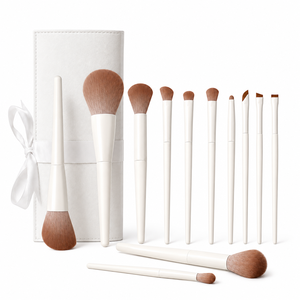
Modern cosmetic formulations—ranging from ultra-lightweight water-burst serums to high-pigment cream foundations and micronized mineral powders—behave differently depending on the mechanical delivery mechanism. Premier bamboo beauty tool manufacturing goes far beyond handle aesthetics: it requires molecular-level alignment between synthetic bristle fiber geometry, ferrule crimping pressure, and handle weight distribution to optimize product pick-up and pay-off efficiency.
Material Science: Bamboo & Synthetic Fiber Dynamics
Engineering High-Performance Applicators for Modern Liquid, Cream, and Powder Formulations
A primary failure point in traditional wooden makeup brushes exported globally is moisture absorption, leading to handle swelling, lacquer cracking, and eventual ferrule detachment. As a leading China bamboo beauty tools exporter, our manufacturing standard integrates a multi-stage carbonization and hydrophobic sealing protocol designed to guarantee zero dimensional distortion under rigorous sanitization conditions.
1. Hydro-Thermal Carbonization & CNC Milling
Raw bamboo poles undergo high-pressure steam treatment at temperatures between 160°C and 200°C. This process caramelizes naturally occurring sugars within the bamboo fibers, neutralizing nutrients that could otherwise attract pests or micro-organisms. The stabilized bamboo strips are subsequently kiln-dried to a precise moisture content of 6%–8%, then precision-machined using multi-axis CNC lathes to achieve strict dimensional tolerances (±0.05mm).
2. Eco-Friendly Hydrophobic Barrier Coatings
To preserve the natural tactile texture of bamboo while providing full liquid defense, handles are sealed using UV-cured water-based polyurethane coatings or natural botanical wax emulsions. These non-toxic coatings prevent liquid foundations, serums, and cleaning solvents from penetrating the wood grain, complying strictly with REACH, FDA, and EU REACH Annex XVII chemical safety standards.
3. Micro-Engineered Cruelty-Free Fiber Formulation
In accordance with corporate ESG commitments, modern beauty tools completely replace animal hair with engineered synthetic fibers. Utilizing advanced extrusion technology, synthetic filaments (PBT and PET) are manipulated at the microscopic level:
- Micro-Crimping & Texturizing: Simulates the natural cuticles of goat or pony hair, allowing powder formulas to cling evenly to the sides of the bristle bundle rather than falling to the base.
- Dual-Taper Tip Polishing: Mechanically acid-etched bristle tips narrow down to 0.02mm, producing an ultra-soft skin feel that eliminates micro-scratching on sensitive facial skin.
- Zero-Absorption Liquid Fiber Technology: Hydrophobic filament coatings prevent liquid foundation and oil-based serums from soaking into the fibers, reducing product wastage by up to 35% compared to conventional sponges.
Global Procurement Decision Matrix
Comparative Evaluation of Substrate Materials in Beauty Tool Manufacturing
| Material Type | Renewability Cycle | Carbon Footprint (kg CO2/kg) | Moisture Resistance | Tensile Durability | EUDR & ESG Compliance |
|---|---|---|---|---|---|
| Moso Bamboo | 3 - 5 Years | -1.3 (Net Negative) | High (Post-Carbonization) | Very High (28,000 PSI) | 100% Compliant (Grass Species) |
| FSC Birch / Beech Wood | 30 - 50 Years | +0.85 (Neutral/Low) | Moderate (Prone to Swelling) | Moderate (12,000 PSI) | Requires Strict Due Diligence |
| Virgin ABS/PCR Plastic | Non-Renewable / Recycled | +3.10 (High Carbon) | Immune to Moisture | High (Flexible) | Subject to Plastic Packaging Taxes |
| Anodized Aluminum | Bauxite Mining / Recyclable | +8.90 (Very High) | Immune to Moisture | Exceptional | Energy Intensive Supply Chain |
The 6-Step OEM/ODM Manufacturing Workflow
From Initial Concept & Engineering to Global Batch Delivery
Formula Brief
Alignment on cosmetic viscosity, target market price positioning, and ergonomic requirements.
Industrial Design
3D CAD modeling of handle geometry, ferrule crimping style, and fiber blend ratios.
Rapid Prototyping
Precision CNC sample turning and hand-tufted bristle assembly within 7–10 business days.
Formula Testing
Lab evaluation for fiber drop-out rate, tuft retention (pull test > 15N), and sanitization stability.
Automated Production
Automated tufting, laser etching of brand logos, and multi-stage inline visual inspection.
Global Logistics
Audit-ready batch documentation, drop-test certified packaging, and worldwide freight dispatch.
Enterprise Manufacturing & Responsible Sourcing Standards
Partnering with an established exporter ensures seamless compliance with international trade protocols. Backed by corporate design hubs in Atlanta, New York, and Los Angeles, combined with advanced manufacturing facilities, our production ecosystem adheres strictly to ISO 22716 (Cosmetic GMP), SA8000 (Social Accountability), and BSCI factory audit guidelines. Every batch of beauty tools shipped undergoes rigorous quality control checks, including pull-force testing, ferrule adhesion validation, and microscopic fiber alignment verification.
B2B Sourcing FAQ: Bamboo Beauty Tools
Essential Technical and Logistics Insights for Procurement Managers and Product Developers
Why is bamboo considered superior to traditional wood handles for cosmetic brushes?
Bamboo is a fast-growing grass species, not a tree, meaning it regenerates naturally after harvesting without damaging root systems or contributing to deforestation. Mechanically, carbonized bamboo possesses higher tensile strength and dimensional stability than conventional hardwoods. Furthermore, bamboo’s natural "Bamboo Kun" antimicrobial properties provide inherent resistance to fungal and bacterial proliferation, which is critical for skin hygiene tools.
How do China bamboo beauty tool exporters ensure EUDR (EU Deforestation Regulation) compliance?
Because bamboo belongs to the Poaceae family (grasses) rather than timber trees, it falls outside the restrictive deforestation scope applied to primary wood products under EUDR. However, top exporters maintain full supply chain traceability, providing geographic coordinate mapping and FSC (Forest Stewardship Council) chain-of-custody documentation for all bamboo culms harvested, ensuring smooth customs clearance into European markets.
What customized OEM branding options are available for bamboo handles?
We provide multiple high-precision branding techniques tailored for natural bamboo surfaces:
1. Laser Engraving / Pyrography: Creates a tactile, permanent mark by burning the logo directly into the wood grain without inks or chemicals.
2. Precision Pad Printing & Silk-Screening: Uses eco-friendly, heavy-metal-free inks for vibrant pantone color matching.
3. Hot Foil Stamping: Delivers metallic silver, gold, or rose-gold decorative finishes.
4. Custom Ferrule Anodization & Embossing: Customizes aluminum or brass ferrules with debossed brand logos.
What is the typical Minimum Order Quantity (MOQ) and sample lead time for custom bamboo tools?
Standard minimum order quantities for private label custom bamboo makeup brushes and skincare tools typically start at 1,000 to 3,000 units per style, depending on handle complexity and custom fiber dye requirements. Pre-production functional samples are turned and dispatched within 7 to 10 business days, while full mass production runs are completed in 30 to 40 days following final sign-off.
How do synthetic brush fibers compare to traditional animal hair in liquid foundation performance?
Engineered synthetic fibers (such as micro-textured PBT) outperform animal hair in liquid and cream applications. Animal hair features porous cuticles that absorb liquid formulations, leading to product trapping, streaky application, and rapid microbial growth. Engineered synthetic filaments are non-porous and hydrophobic, releasing up to 98% of the absorbed formula onto the skin while remaining effortless to clean and sanitize.
What steps are taken to prevent ferrule detachment over long-term consumer use?
Ferrule detachment is prevented through a dual-locking mechanism: first, the bamboo handle neck is CNC-turned with a recessed retention groove; second, medical-grade, water-resistant polyurethane adhesives are applied before mechanical double-crimping using high-tonnage pneumatic presses. Every production batch undergoes standardized pull testing (resisting over 15 kilograms of linear tension) and thermal cycle immersion testing.